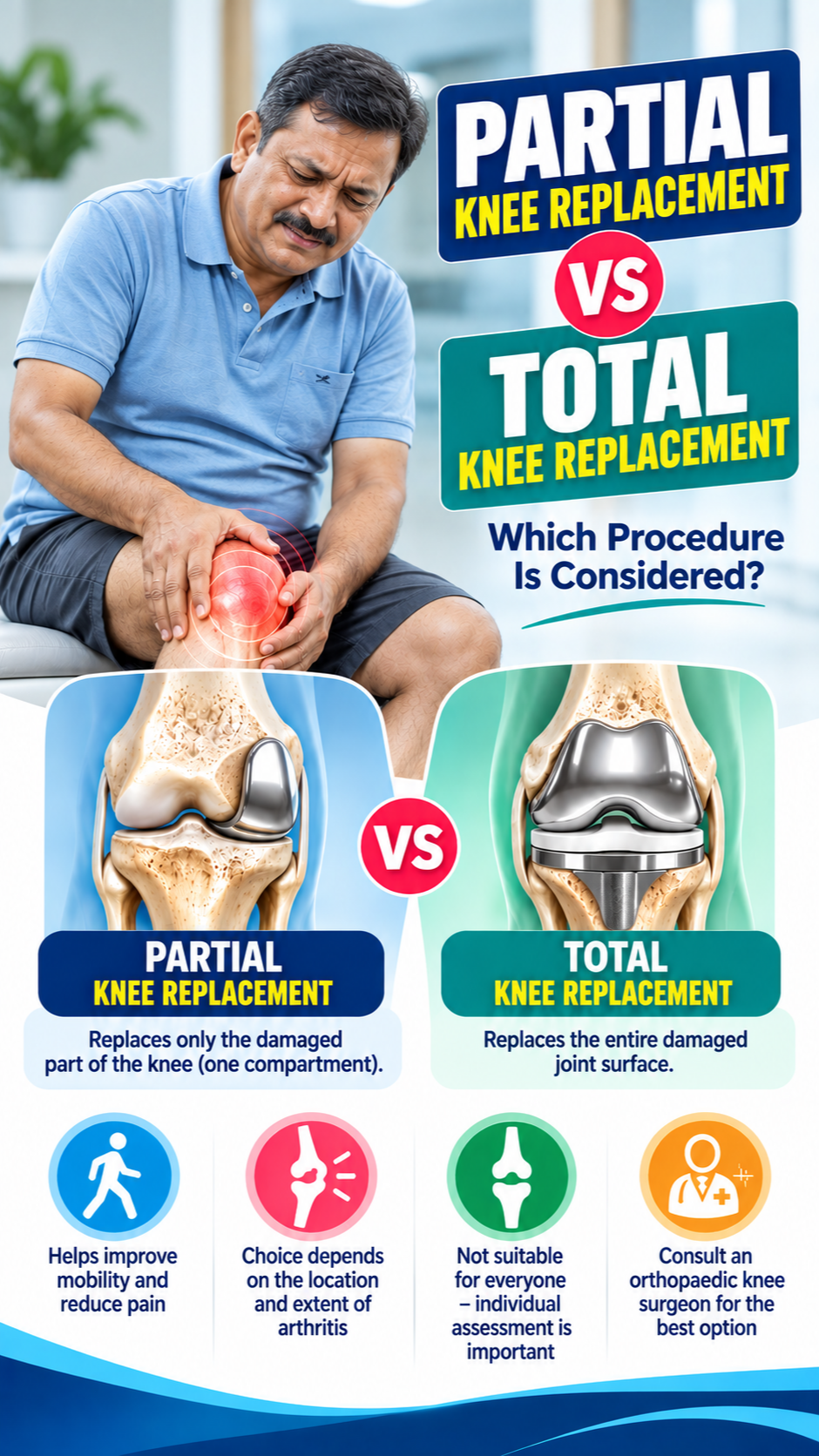
Patients with knee arthritis often encounter two surgical terms: Partial Knee Replacement and Total Knee Replacement. Although both procedures are designed to address damaged parts of the knee, they are not interchangeable. The appropriate option depends on the location and extent of arthritis, ligament condition, symptoms, age, activity level and findings on clinical examination and imaging.
For patients considering treatment in Pune, understanding the basic difference between these procedures can make an orthopaedic consultation more productive.
What Is Partial Knee Replacement?
A partial knee replacement, sometimes called unicompartmental knee replacement, replaces the damaged compartment of the knee while preserving healthy areas of the joint.
The knee has three major compartments. If arthritis is substantially limited to one compartment and the rest of the knee is suitable, partial replacement may be considered.
Potential advantages can include preservation of more natural knee structures and a smaller area of the joint being replaced. However, these benefits depend heavily on appropriate patient selection.
Partial knee replacement is not suitable for every person with knee arthritis.
What Is Total Knee Replacement?
Total knee replacement involves replacing the damaged joint surfaces of the knee with artificial components. It may be considered when arthritis affects multiple compartments or when the extent of joint damage makes a partial procedure unsuitable.
People with advanced osteoarthritis may experience:
Persistent knee pain
Difficulty walking
Pain while climbing stairs
Reduced ability to stand for long periods
Stiffness
Difficulty performing everyday activities
When non-surgical treatment no longer provides sufficient relief and joint damage is advanced, total knee replacement may become an option.
How Are the Two Procedures Different?
A simplified comparison is useful:
The final choice should not be based on age or preference alone.
Why Imaging and Examination Matter
An X-ray may show where arthritis is present, but the decision involves more than looking at a scan. An orthopaedic surgeon also evaluates knee stability, movement, ligament function, deformity, pain pattern and the effect of symptoms on daily activities.
For example, a patient may have apparently localized arthritis but still have other factors that make partial replacement unsuitable.
Is Partial Replacement Always the Easier Choice?
Not necessarily. The less extensive nature of the procedure does not automatically make it appropriate. A partial knee replacement depends on careful patient selection and accurate assessment of the affected compartment.
Similarly, total knee replacement is not automatically required simply because arthritis is advanced. The treatment decision should reflect the individual's symptoms, examination and imaging.
Patients in Pune seeking guidance from a Knee Replacement Surgeon can discuss whether their arthritis pattern is compatible with partial replacement, total replacement, or continued non-surgical management.
Dr.Ulhas Sonar Consultant Orthopaedic and Knee surgeon in Swargate, Pune, evaluates knee conditions with attention to the underlying joint problem rather than relying on a single symptom or X-ray finding.
Understanding the difference between partial and total replacement is useful, but the most important question remains: Which procedure is appropriate for the specific knee being treated? That answer requires an individualized orthopaedic assessment.